Wednesday, October 19, 2016

DRSS: Where Chemistry & Writing Meet


6th graders and 11th graders worked together on usability testing.
By Katie Jones
Middle school and high school merged when the 11th graders did a project involving chemistry, Technical Reading and Writing, and the 6th graders. Often, these two sides of DRSS remain separate, but for this they worked together. 
 
The 11th graders' part of this project involved writing a set of instructions for a chemistry experiment. The experiment had to do with the displacement of water due to the chemical reaction of baking soda and vinegar. They first performed the experiment themselves in their chemistry class, and then learned how to write instructions for the experiment in their Technical Reading and Writing class. 

After learning how to write clear instructions, the 11th graders made instructions in a variety of formats, including written instructions, posters, and videos. 
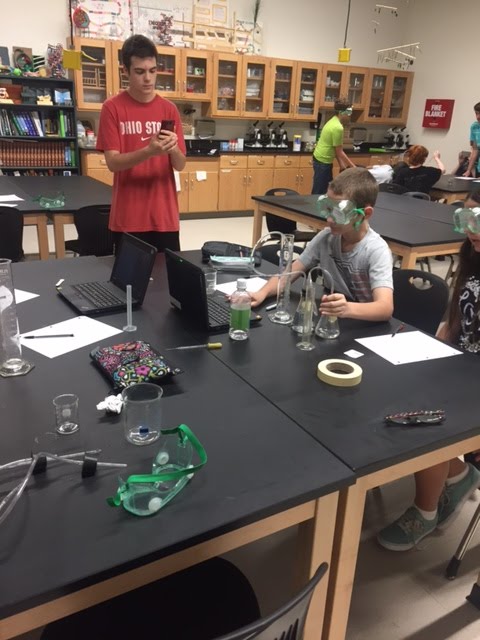
A 6th grade student tests the directions provided to him while an 11th grader records the results of the usability tests.
For the 6th graders, this experiment involved providing feedback by testing the experiment instructions written by the 11th graders. On the 22nd of September they were put into groups of 2-4 and went to either Mrs. Kancler or Mrs. Campbell's room to test out the instructions. Depending on which group's instructions they tested, they also did concurrent or retrospective testing. 
Students testing the directions provided to them by the 11th graders in Chemistry and Technical Reading & Writing
For the groups who did concurrent testing, or evaluated the instructions by watching the 6th graders do the experiment, this included the "Think Aloud" method. The "Think Aloud" method is where the testers, in this case the 6th graders, would say everything that they thought while doing the experiment. Other groups used retrospective testing to get feedback for their instructions in the form of a survey, taken after the experiment. Still other groups used a combination of the two methods in order to collect as much feedback as possible to improve their instructions.

This project exemplifies one of the DRSS qualities: collaboration. Not only are the 11th graders collaborating between classes, but they’re also collaborating between grade levels. Bri Perkins, a junior, said “Collaborating with the sixth graders was fun. I haven’t worked with them yet since our grades are so separated and finally getting their insight was interesting. Their feedback is good and they were a great audience.” This shows that this is a project that will help both grades, as no matter where they go in life, being able to collaborate with others will help them to move forward.

Alumna Profile - Bethany Wilson

By DRSS Newsroom Journalist Bri Perkins 

Bethany Wilson graduated from the Dayton Regional STEM School last year. She started DRSS in the year of 2012 as a freshman. She is currently enrolled in Sinclair Community College taking courses such as mathematics, metrology, precision machining, and principles of manufacturing. 
Bethany Wilson, DRSS Class of 2015, pictured here during her NASA internship.
When asked why she enrolled in Sinclair, she responded with, “Because of what I learned taking economics with Mr. Grieve. I want to graduate from college debt free.” She hopes to become a welding engineer.

When asked how Sinclair is going so far, she responded with, “My experience at Sinclair has been amazing. I can tell that the courses I took at DRSS, and the expectations teachers had for me have made a different in how my first few weeks are going.” 

Bethany didn’t always know she wanted to become a welding engineer. During her freshman year at DRSS, she admits to wanting to become a rescue swimmer for the United States Coast Guard. However, all that changed when she took Ms. Whitt’s class for biology. After taking her class, Bethany then wanted to become a Bio-Medical engineer. Yet, after interning at N.A.S.A. she changed her mind. Now, she is focused on becoming a welding engineer, but she says if that doesn’t work out, she would most likely become a high school teacher in either history or government.

Looking back on her years at DRSS, Bethany noticed some things. “I was someone who really didn't like doing digital portfolios. However, I plan on keeping mine updated with projects I’m doing now; that will be impressive to future employers. Using proper email etiquette and actually talking to your professors, and emailing them is something that STEM prepared me for and I didn’t even realize it when I was there.” 

Bethany also went on to say how DRSS prepared her for entering a mostly male-dominant field, saying how she is one of the only girls in some of her classes.  “I do miss STEM a lot. I miss a lot of specific teachers. Usually the ones where I struggled with their course and had to spend extra time with them. Not having familiar faces at every turn isn’t something I’ve had to deal with for the last four years because of the family that is STEM. Not having staff members that know you by name, and care for you on a personal level is probably the hardest part of leaving.” 

Although she misses DRSS, she is happy to finally be in the real world and have choice over what she studies. Yet, she also goes on to say, “I’m not too fond of having to start paying taxes or having to find a spot in the parking garage before my 8 am classes.”

Bethany was a familiar face for both classmates and staff members for her four years at DRSS. We miss her greatly and hope she is successful in whatever she chooses to be!

Tuesday, October 18, 2016

Lunch is Served

Ms. Anita, the owner of Baked by Anita.
 By Chloe Johnson

DRSS, 10/9/16 - Catering for 400 students in a college dorm room kitchen was Ms. Anita’s first experience with her passion. She would later go on to cater for an entire month before she realized she wanted to do this for a living. Her company, Baked by Anita, started in February 1993, and she began catering for various different companies and events.

However, she was first introduced to the world of school lunches by one of her clients. Ms. Anita said, “One of my clients had a child in a charter school in Cincinnati and asked if I was interested in serving a school because her children were not happy.” She took the offer and began serving the school in 1995. During the summer time, she served a Girl Scouts camp with approximately 300 campers for all three meals (breakfast, lunch, and dinner). That led her to serving school lunches and recognizing her company’s goal was to provide fun-loving and well-balanced meals in USDA guidelines at the same time.

Interestingly, the name of the company was created because Anita used to bake for most of her catering events. That is how she came up with Baked by Anita. Her business not only serves DRSS students, but also serves Mound Street Academy and Richard Allen Schools (two locations in Dayton and one in Hamilton). The lunch meals are inspired by what the students suggest and what her employees and Ms. Anita observe. For instance, the burrito bowl resembles Chipotle, a fast food restaurant at which many students enjoy to eat. Ms. Anita said, “Anything that resembles fast food seems to go over well.” All of the recipes are tried before they are given to the students. Each month, the company has a meeting to toss around ideas about what to serve the students and how to make the meals more fun. An example is chicken spaghetti. She doesn’t have a favorite meal to serve to the students, but she knows the students really enjoy the nachos, chicken bowl, and cheeseburger casserole. “Things that are very familiar; people tend to really enjoy those,” Ms. Anita stated.

On a typical day, the cooks go in at 6AM to prepare the food, cook the food, and store the food to be delivered to the schools from their main campus in Dayton. After the product is prepared, the cooks put the food into cambrios (industrial plastic containers) or upright warmers. These containers maintain the food for four hours at the proper temperature. The employees load the van with the containers and make sure they have everything they need to serve the meals. They come over to DRSS to unload, get set up, and serve the lunches.

Students enjoy the new school lunches and the people behind the counter, too. Tanijah Finney, an 11th grader at DRSS, stated “You also have freedom of choice.” No longer are students restricted to drinking milk only or having to eat whatever is being served. They are provided with options to put on their burrito bowl and chef salad. Also, students have a choice of juice instead of milk. She believes, “Yes, it is worth your money. I think if the food tastes better, more people would be willing to buy it. In this case, the food does taste better.” Kellyn Borkenhagen, also an 11th grader at DRSS added, “Well, they have a much better taste, seem more prepared, and there is more thought put into it. Also, the lunches seem healthier. Now, there is a fruit provided every day.” Besides the students, employees love working there, too. Damare Reason, who just started working there this year, said, “I love working with Baked by Anita. They make me feel at home and I like cooking, so I fit right in.”

On a final note, Ms. Anita liked the school lunches and liked the lunch people when she was growing up. That is why her company works so hard to provide the students with a good experience. She wants to the students to be happy. As a student at DRSS, I am thankful to have such wonderful lunch providers who care so much about the quality of the food and service.

Dayton Regional STEM School and Vectren Partner to Prepare Region's Future Engineers


KETTERING, OH, 10/18/16 - The Dayton Regional STEM School (DRSS) and Vectren have announced a new partnership aimed at further developing the region's pipeline of future engineers.

The program, "DRSS's Engineering Career Tech Pathway Powered by Vectren," kicked off at the start of the 2016-17 school year. The school used Project Lead the Way curriculum and Ohio Department of Education guidelines to create the engineering program while ensuring the program utilizes a Project Based Learning approach as well as career exploration opportunities.
The partnership with Vectren provides DRSS students the opportunity to meet and collaborate with engineers who work in a variety of positions within Vectren.
"This new pathway is a crucial component of our ever-expanding Career Exploration model at DRSS and will provide students with a head start in their post-secondary education," DRSS Superintendent Robin Fisher explained. "We are extremely grateful to Vectren for investing in the program."

"Vectren is proud to partner with the Dayton Regional STEM School to provide our region's students with the building blocks to an engineering career and opportunities for career exploration in high-demand STEM fields," said Colleen Ryan, president of Vectren Energy Delivery of Ohio. "A solid educational foundation is key to ensuring our students have access to and can succeed in local high-demand jobs."
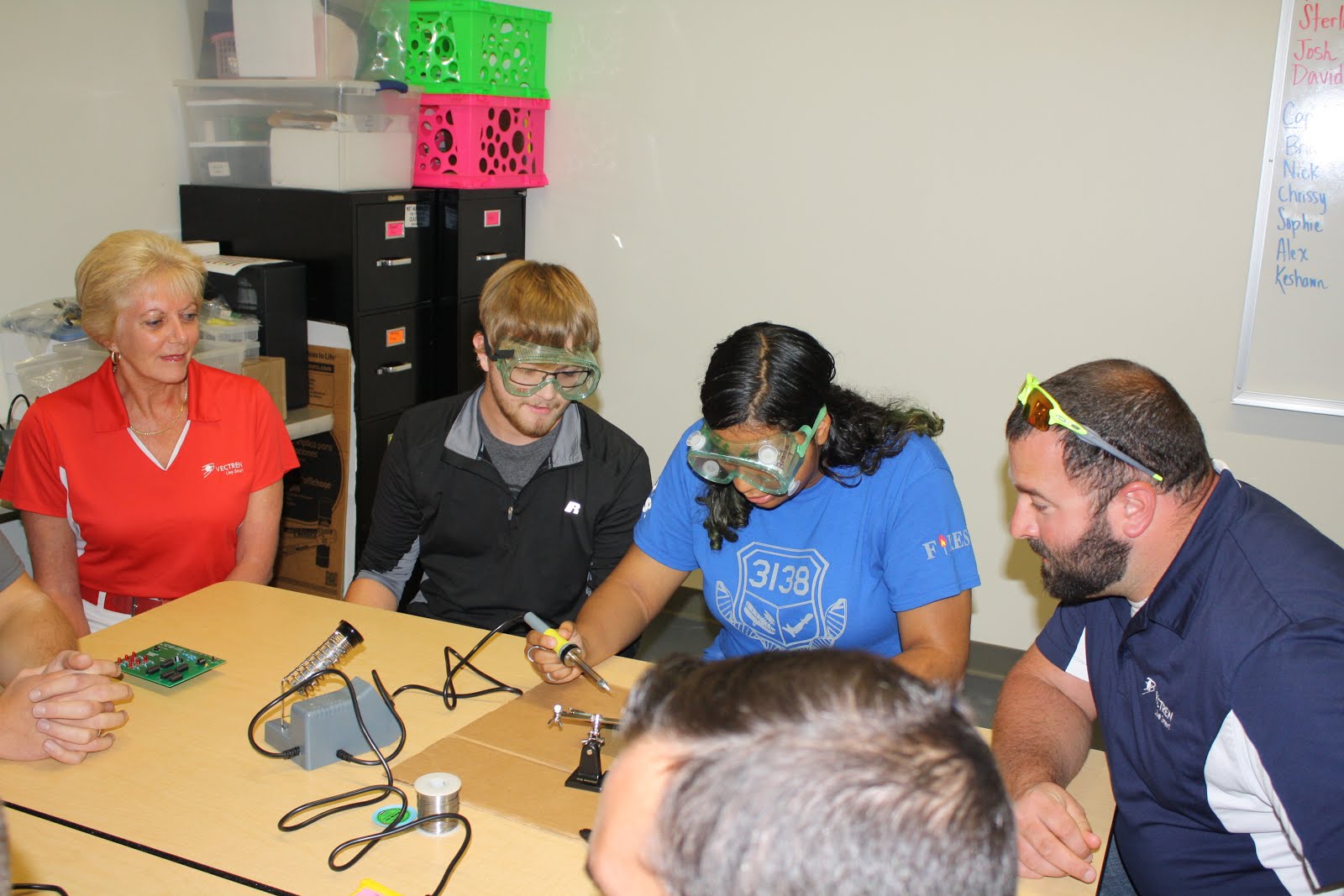
Orlando Ching demonstrates what he has been learning in his Digital Electronics course to representatives from Vectren.
The program provides students with the foundation necessary to successfully enter engineering careers. Two of the courses, Principles of Engineering and Introduction to Engineering Design, are already offered to DRSS high school students. Two courses, Digital Electronics and Environmental Sustainability, are new this year and are being taught by Kathryn Reilly, the new Coordinator for the Engineering Career Pathway. 

"New content development is what excites me," Ms. Reilly said, "so I'm thrilled that Vectren is a part of this program, particularly because there are so many opportunities for their employees to work with our students throughout the year on specific projects and industry-specific problems."
Becuase of the partnership, students have the opportunity to engage with real-world engineers through their curriculum and through projects.
At DRSS, exposure to engineering concepts begins in sixth grade, where students spend nine weeks exploring the building blocks of engineering. These concepts continue through seventh and eighth grade in their STEM Foundations curriculum. By introducing engineering concepts in middle school, the goal is to help students feel more comfortable and prepared to enter advanced study in high school when they can enroll in the Engineering Career Tech Pathway.

DRSS Principal Hope Strickland was also enthusiastic about what this program will mean for the students." One aspect of Vectren's support of this program includes the opportunity to host a 'Vectren Day' during the school year where engineering program students can learn from and engage with a panel of Vectren engineers about their careers," explained Mrs. Strickland. "We are really grateful that Vectren not only wanted to help fund the program, but truly partner with the school in helping us to educate our students."

Reason #35 The Future is Bright at DRSS: Dedicated Intervention Specialists


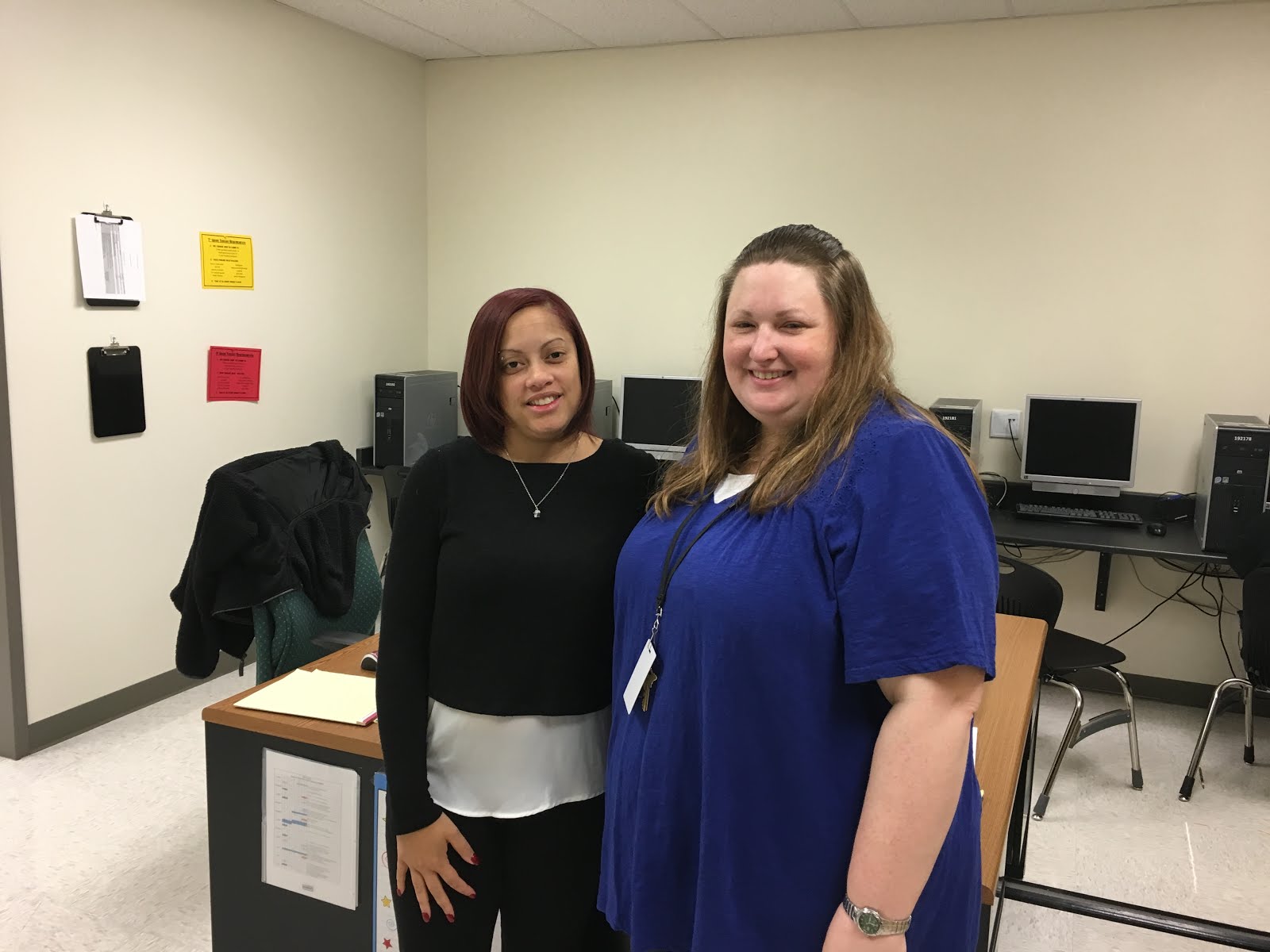
Intervention Specialists Azure Hickman and Betty Henderson ensure DRSS students on IEPs have the support they need in the classroom.

By Rachael Stowe

Kettering, 10/18/16 - DRSS prides itself on the diversity of our student body. But when it comes down to those who use an IEP (individualized education plan), we often get caught up on how their education at STEM works. To learn more about them and their education, I interviewed both Ms. Hickman and one of the students she oversees (who for privacy reasons must remain anonymous).

Ms. Hickman’s room is a cozy spot tucked away from the stress of STEM. Located by the gym, this dual-room area has everything a conventional classroom would. Computers line the back wall; there are desks and chairs too. There are various comfortable places to sit and do work all around the perimeter of the room. There’s even a white board with all the homework for each class written on it.

The preconceived notion that students who benefit from an education assistance program receive answers or less work is prevalent. However, this is simply not the case. Students on these types of plans learn the same exact content as any student in the same class down to the dot, but the material is just formatted differently so it can be better understood. Essentially, the material itself is just modified in the way it is presented. Questions can be rephrased to more directly and clearly state what it is asking. Or readings can be broken up into smaller sections for more directed focus. Important and crucial points can be emphasized more so the topic is more understandable. At the core of it, these are all things that many students already do to help boost their educational experience while making the most efficient use of their time.

Another thing that is heavily stressed is that every student who utilizes an individualized education plan is different. Some students do better with auditory learning, while struggling with written expression. Other students are more visual learners, while struggling with auditory learning. Each student on an IEP has their own strengths and weaknesses, and their plans are formatted to fit this.
While there are many similarities between IEP students and non-IEP students, there are also huge differences. They sometimes have difficulties speaking up or asking questions in class, because they often feel like they will be perceived as unintelligent. Sometimes, concepts are harder for them to grasp.

The benefits are tremendous, according to Ms. Hickman, who explained that "students are making a lot of progress because they're staying in the regular classroom, where their peers are models for them. Challenging them day after day gives them a sense of pride and they are able to make gains in areas where they struggle and are weak. If we pulled them out, they'd lose that direct group instruction they get with their peers."

"Our model allows them to flourish by providing them with peer supports" explains Mrs. Henderson, who works alongside Ms. Hickman each day. "Other schools that don't do that lose out on opportunities their students could be taking advantage of," she explained.

And as for the student I interviewed, they just want people to know that they are just as capable as we are. They have goals and dreams and, just like us, they will accomplish them. When I asked if they felt like since they started being on an IEP they had been able to reach their full academic potential, they simply said that they use everything they have been taught over the years and work step by step, and they think that they haven’t quite reached their goals yet, but they are getting there. And aren’t we all?

Wednesday, October 12, 2016

Cyber Girls Dominating Cyber World


The inaugural members of the Cyber Warrior Princess Club
By Julia Doyle

The Cyber Warrior Princess Club gives girls a new look on computers. When it comes to cybersecurity, they are your girls. So boot up and get ready, it’s time to go through cyberspace.

Cyber Warrior Princesses is a brand new club, which just started this year, and it was introduced at the open house. Some of the topics students explore include things like how to stay safe on the internet and that not all hacking is bad. 

Rebbeca Onuskanich is the volunteer who is teaching the Cyber Warrior Princess Club every Wednesday afternoon. When asked why she wanted to start the club, Rebecca explained, "I want to get more girls more interested in Cybersecurity. With females representing only 11% of  Cybersecruity positions, its important that we expose females to this field at a young age!" 

The program is also geared towards career exploration. As Rebecca explained, "this club will have a huge impact! We currently have a pipeline issue in that there are over 209,000 open [Cybersecurity] positions in the US, and colleges and universities are just now providing a degrees in Cybersecurity. This leaves us with a tremendous shortage of qualified and trained individuals. When this happens, the best way to immediately fix the problem is through training."

Rebecca describes a promising future for students who go into Cybersecurity, claiming that, "with the appropriate training and certifications, high school students could get a job in Cybersecurity upon graduation and then go to college while working."

When you go online, you may think that whatever you post or do can be deleted, and that's not true. When you put something online you can't take it back. Someone can take a screenshot or forward it to someone else before you can do anything. Some parents have software installed on your computer, so they see what you websites you looked at and what you said at the end of the month, even if you delete it. 

Another lesson the club teaches students is that when they make a post on the internet, anyone, anywhere can see it. Most people wouldn't go up to a stranger and say “here is my address, my phone number, my school and pretty much all my personal information,” so why do they do it on the internet? This is what the Cyber Warrior Princess Club teaches students about. They show you what it is okay to post, what's not okay, and more.    

You might be surprised to hear not all hacking is bad. I’ll explain why. When you hear the word “hacking,” most people think of a person behind a computer screen stealing money online, hacking a game to win, or taking your information, but that's only one definition. Have you ever thought of yourself as hacking in everyday life? For example, when you take a shortcut through a maze, that's hacking, only in a different way. When somebody takes data for money without permission that is black hat hacking. That means that they steal stuff to sell or get into things they are not supposed to do. When people hack things to test security when they are hired by that company, they are white hat hackers. They are looking for ways to make the data more secure.

Students in the club are excited about what they're learning. When I asked Eve what she could expect to do in the club, she said she wants to "learn about hacking." Another student, Chrys, explained that she hopes to go into Cybersecurity after she graduates, so this club is right up her alley!

One thing is clear, and that's that the Cyber Warrior Princess club teaches girls important lessons about technology and staying safe online while exposing them to exciting future career opportunities.

Friday, October 7, 2016

Ohio Needs Voters

11th Grade Government students working on their informercial projects

By Maya Quale
It’s that time of the year again: Americans head to the polls and make one of the most important decisions we, as citizens, make. To help aid Ohio voters’ decisions, the students of Ms. Durkee’s 11th grade Government class are creating infomercials and logistic videos to help give Ohio voters all of the information they need to vote in the 2016 and future elections. 
 
Each group creates an infomercial and logistics video. For the logistics video each group has chosen an issue to give general info about and the candidates' platforms on an issue. The infomercial topics are healthcare, gun control, college education, general education, families and children, social security, and environment. In the video are statistics, the candidate’s opinion on the topic, and how their plan will affect Ohio if they become president. 

11th grade student, Chloe Johnson says, “I believe the infomercial will help viewers understand more about the candidates' policies. Especially since we’re not being biased, by adding information about each candidate. We also include logistics to let the viewers know where and when to vote.” Ms. Campbell, Biology and Anatomy and Physiology teacher, says, “I think it’s great to expose young people to politics, so that they can be informed citizens when they get the opportunity to vote.”

The logistics video gives Ohio voters basic information about how to vote, when to vote, where to vote, what third parties are, what a swing state is and why Ohio is one of them, and what the Electoral College is. All groups have come up with very creative ways to film their videos: stop motion, animation, presentations, whiteboard filming, etc. One group is doing a Lego stop-motion animation video. Another is using a Prezi presentation to film using Screencastomatic.

Be sure to catch their videos on Ms. Durkee’s YouTube channel October 19th, and join us at DRSS as we watch the final Presidential Debate. The students' commercials will be playing before and after the debate watch party. 

You can register here if you plan to attend the Debate Watch Party on October 19!