Friday, October 28, 2016

Let’s Do Some Environmental Engineering!


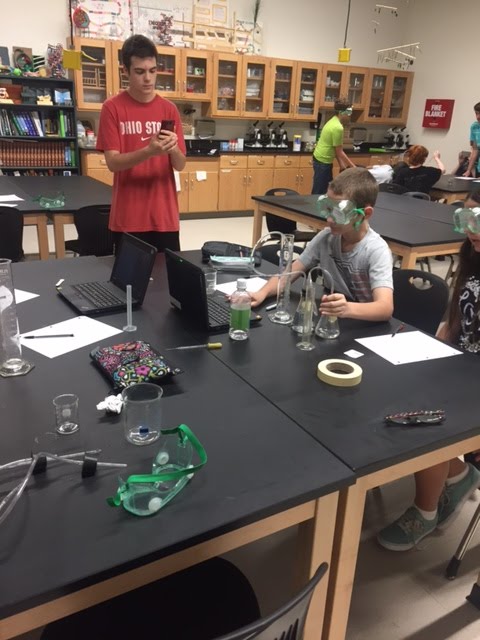
Students of the Environmental Engineering elective show off their projects.

Editor's Note: DRSS's Engineering Career Tech Pathway is now Powered by Vectren. Learn more about this new partnership here!
 
By Neeti Prasad, 8th Grade

Ms. Kathryn Reilly is the teacher of the new Environmental Engineering (EE) elective for juniors and seniors. I interviewed Ms. Reilly about the main purpose of the class.

Engineering is in our school name, so you know how passionate students feel about it. For this reason, DRSS created this new elective for juniors and seniors, so that they could explore this field of engineering. I first asked Ms. Reilly about the kinds of students that she would recommend this class to, and she answered by saying that this class is great for any student who isinterested in research, problem solving, ethics, discussion, and collaboration.” If you enjoyed the Sustainability class in 6th Grade, EE would be an ideal choice for you. 

Classes like this one can be both fun and an opportunity to learn important concepts. I asked Ms. Reilly about the major points that she would want her students to get out of the class. She said the following, “I hope students leave the class with a better understanding of some of the behind-the-scenes procedures environmental engineers handle. Behind every good investigation and cool lab there is a lot of research, discussion, ethics, and note-keeping. I also hope students will leave with a sense of awareness about the world and with a desire to do their part to make it better.”

A class at STEM is not complete without a couple of good projects and the new EE class is no exception. In the water quality unit, students first collected water samples from the drainage ditch, puddles, sinks, drinking fountains, and bathrooms. They then analyzed these water samples for potability and wrote a case study to see if the water quality was within safe limits. They completed multiple tests for 5 different categories. They conducted a turbidity test which is the test to see how clear the water is, to make sure that there are no sediments or dust in the water. Next they did a pH test, to see how acidic the water. After that the students checked to see how much ammonia, nitrates, and sulfates were in the water. If you want to figure out if the water you are drinking is safe, you know who to go to now! 

Our education lays the foundation for our eventual careers. So I asked Ms. Reilly about the impact of this class on a student’s future. “This class could give students an idea of the type of day-to-day activities an environmental engineer carries out to determine water quality, food solutions, or renewable energy.” She went on to say that this class could help narrow down possible career choices for students. 

This is a brief introduction to what this environmental engineering class is. If you would like to learn more about this class, contact Ms. Reilly.  So, a big welcome to Environmental Engineering from all of us at the Dayton Regional STEM School, and thank you to Vectren for powering our bright future!

Wednesday, October 26, 2016

Alumna Profile - Erin Paquette, Class of 2013

Erin Paquette, pictured here holding a red-tailed hawk, is set to graduate from Wright State this year.
It only takes a minute of conversing with Erin before realizing that she knows a lot about animals and loves teaching others about them. "I like telling people about nature and all the cool things there are in the outdoors,” she explains. “My favorite animal is the Giant Ground Sloth. I just want to clone one and name it Timothy."

Erin Paquette graduated from the Dayton Regional STEM School (DRSS) in 2013 as part of the school’s first graduating class. After graduating she went to Wright State University, where she’s completed three internships and is set to graduate from the College of Science and Mathematics with a degree in Biological Sciences. Erin will graduate debt-free from WSU thanks to a scholarship she received from the Wright State Research Institute (WSRI).

Erin’s scholarship required her to complete three internships during her time at Wright State, a fact that she considers to be an amazing opportunity as opposed to a requirement. Currently she is seeking out a fourth internship and has applied to the Boonshoft Museum of Discovery and Brukner Nature Center, the latter of which is currently considering her application. 

“My first internship was in 2014 working at Aullwood Audubon Center and Farm, where I helped with the Summer Adventure program by working at their day camp as a naturalist,” she recalls. While there, Erin had the opportunity to handle many different types of animals, some of which were less popular than others. She was the only one willing to handle the big snakes, like the Copperheads, for example.

Erin believes her time at DRSS helped her secure this first college internship. "I actually job shadowed at Aullwood during my high school experience (with Sarah Alverson), and so they already knew me going into the interview process at Aullwood. So aside from my experience working with kids in the past, they knew I could handle snakes and things and not run away from kids and scream."

After her first experience she completed another internship with Dr. John Stireman in the Entomology lab at WSU. There, she identified, sorted, and learned about bugs. She also helped with research, such as “trying to see if Tachnidae [a large family of what are known as ‘true flies’] lay their eggs on stink bugs, which typically result in the death of the stink bug."

Her third internship took her to Norfolk, VA, where she worked as a Program Animal Building Manager at the Norfolk Zoo, going out to schools and interacting with the public. During this time she also helped with their “Zoo Live” shows by bringing out different animals and teaching the visiting children about their unique peculiarities. “The Madagascar Hissing Cockroaches hissed more than I liked,” she admits, “but I enjoyed getting to handle so many different animals, including a Giant African Millipede, California King Snakes, chickens, and Tenrecs [a small mammal found in Madagascar].”

Erin believes these internships have helped round out her college experience and will be helpful as she seeks to find a job. The experiences have also helped her identify possible next steps after college, which are plentiful. “I’m going to try and go to grad school in the U.K.. I’m currently looking at the University of Sterling, Bristol and Anglo-Ruskin. After that I’d love to work in animal care. I’m also considering teaching English in China for a year,” she explains.

Looking back to her time at DRSS, Erin believes that her Advanced Biology class prepared her the most for her coursework, because “it was half high school and half college, and it was largely self-directed. We had to set up our own schedule, learn how to take notes, and practice different study skills for college.”

"The culture of DRSS has also prepared me for my future career," she adds, explaining that, "It’s just so culturally DRSS to learn how to communicate and present well. I didn’t like doing presentations when I started high school, but it’s very important when you’re doing outdoor presentations to the public, because you don’t have slides. You just have your brain. And interesting facts about animals and insects.”

Wherever Erin ends up after graduation, it’s clear that her future is bright, (and full of animals)!

Student Stock Market Challenge is Serious Fun


11th graders hard at work checking the value of their portfolios as they participate in the Ohio Stock Market Challenge.
Recently, eleventh graders taking Mr. Nuñez's economics this semester have been participating in the Ohio Stock Market Challenge, a program organized locally by Wright State University's College of Business. 
Devin Wade, an economics student, summarizes the project in an interview: “The Stock Market Challenge is using our understanding of the market from class to exchange stocks as a group.” Devin is just one of the students taking economics and participating in this 10-week project. For this project, each group was given an amount of $100,000; this of course being fake money. However, with this money, groups could invest in a simulated stock market. These stocks on the Ohio Stock Market Challenge mirror the actual stock market.
Some students, such as Devin, visit the website nearly six times a day, always preparing for the stock market to crash. Devin says the most frustrating part of owning stocks is that sometimes his group invests in companies, such as NetGear, thinking it will rise when it doesn’t. This has a negative impact on their ranking within the class, region, and their division. 
Students all over the state are currently participating in this Stock Market Challenge. Overall, there are 656 groups currently competing to be number one. What happens if you get number one? A selective few will get the chance to go to New York to see the actual stock market.
Students in Mr. Nuñez’s class also have something to work towards. Besides this being a highly-weighted project, the group who comes in first place out of all the groups currently taking economics will get a $25.00 visa gift card per person. This gives extra motivation to students, while also helping them understand the stock market. 
Points are awarded for the following project requirements: 
  • 20 points goes to actively tracking their portfolio.
  • 20 points goes to creating another portfolio representing a “buy and hold” approach. According to Investopedia, “Buy and hold is a passive investment strategy in which an investor buys stocks and holds them for a long period of time, regardless of fluctuations in the market.” 
  • The next 20 points goes to students developing their own trading strategy throughout the experience. 
  • Another 20 points goes to the essay, set to be written at the end of the quarter. This essay asks students to reflect on whether the active investing or buy-and-hold strategy is better. 
  • 20 more points go to group collaboration.

When asked if he wished he had had projects like this while he was in high school, Mr. Nuñez responded, “Yes, absolutely. With economics, a lot of it can be just looking at charts, figuring out demand versus supply, and reading over economics theory. That’s just not a fun and engaging way to learn, and I wish that the classes that I took in high school and college would have engaged me like this project does.” 
Dylan Flippo, an eleventh grade student says, “This project definitely helped me learn because I am a very visual learner, along with a lot of people I know in my grade. Being able to compete in the Stock Market Challenge and experience it is really helping me better than just learning from a PowerPoint.” Devin agreed, adding, “I think this project definitely helped me learn because I get to see in real dollars [stock exchange numbers] how useful tactics of buying and selling are.” 
When also asked what DRSS quality Dylan is using the most during this project, he responded with, “The quality I am most using is persistence. There were so many times where our balance went so low, and we had to use persistence to keep trading stocks and staying strong. The hardest parts was during the trading periods.” The New York Stock Exchange (NYSE) opens at 9:30 a.m. and closes at 4:00 p.m. every day. 
Devin Wade says that the quality he is most using throughout this project is communication. “I am using communication to consult my group on which stocks to buy or sell.” Buying and selling during this project is a crucial key to having a high ranking.  Most groups follow the “buy low, sell high” rule. What this means is that when a company has just crashed, or is crashing, they buy shares. As that company starts to recover and go back up, they sell their shares. This can create quite a large profit for students. However, if shares are held on too long, the company can crash again, leaving the return negative. 
 “This project was meant to be highly collaborative, highly stressful, and fun. Students so far seem to be really enjoying watching their stocks go up and down throughout the school day,” says Mr. Nunez. Taryn Hughes, another eleventh grade student says, “I am having the best time during this project. I get to work with my classmates and learn skills I will need for the future.”

Wednesday, October 19, 2016

LexisNexis Visits DRSS for Power Lunch

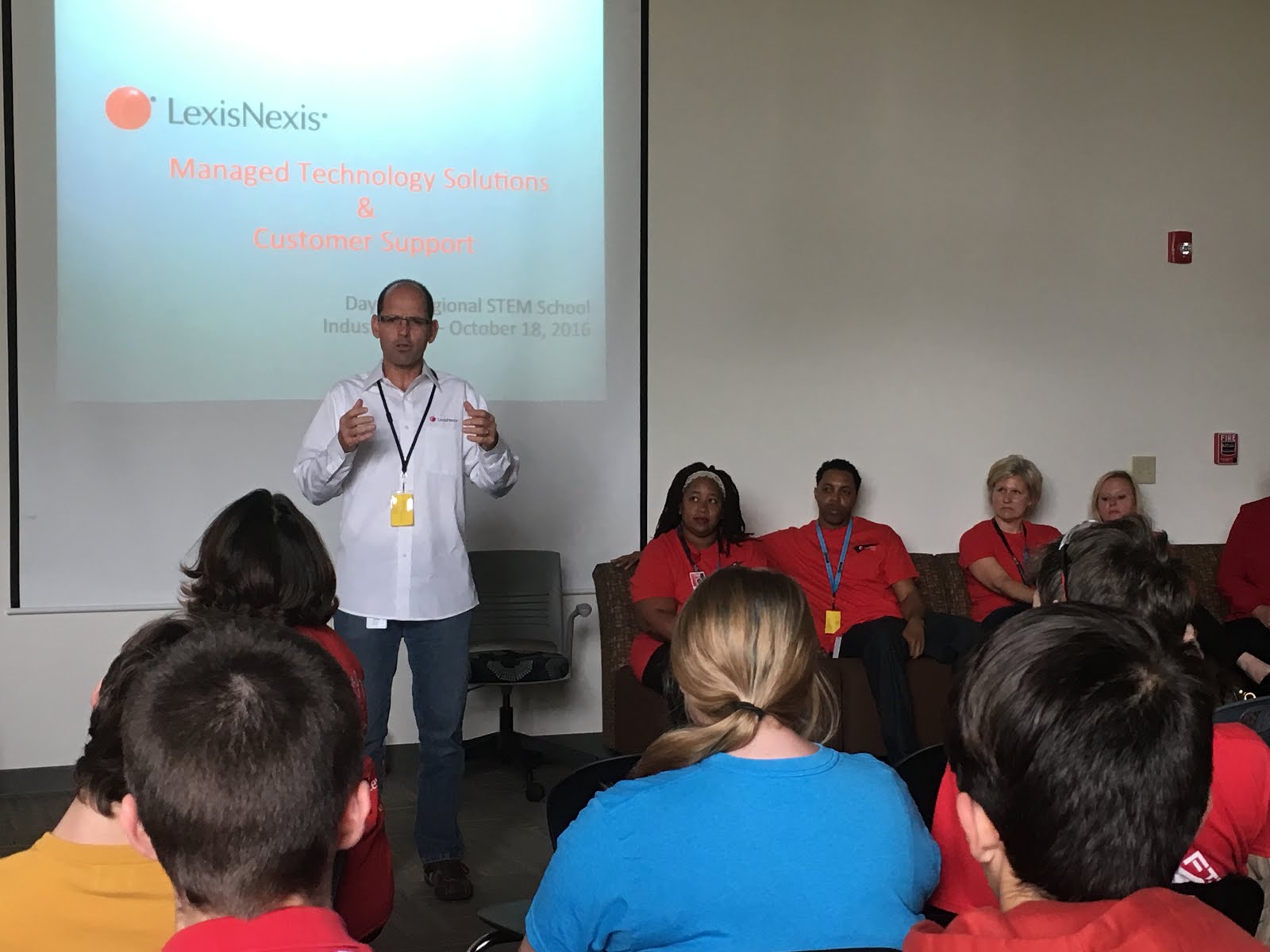
Representatives from LexisNexis visited DRSS on Tuesday, 10/18/16, to profile some of the careers available to students locally in the tech sector.
Kettering, OH, 10/18/16 - Learning about local career opportunities that exist within a large international business is not something students have the chance to do everyday, but on Tuesday DRSS students did just that.

This week, employees from LexisNexis, an internationally-recognized provider of legal, government, business, and high-tech information sources, visited DRSS to meet with students to participate in its Power Lunch program. 

During their visit, representatives from the LexisNexis Managed Technology Solutions and Customer Support divisions sent a team of representatives to profile some of the career opportunities available through their organization’s corner of the tech sector.


Students then had lunch with the presenters, where they had the opportunity to ask them about how they got to where they are today in their careers, what they like and dislike about their jobs, and much more. 

Jackie Anderson, Associate Business Relationship Manager, believes that these visits benefit LexisNexis as well, explaining that, "No doubt, some of the student participants will be innovating right here at LexisNexis in the not too distant future."
 

Community Outreach Director, Arch Grieve, noted the importance of partnerships like these, explaining that, "This visit from LexisNexis is an incredible opportunity for our students to actually interact with individuals who have 'made it' in their careers. The ability of our students to actually sit down, each lunch with them, and ask them how they got to where they are today is huge. We're extremely grateful to the folks at LexisNexis for their support not only of our Power Lunch program, but also for their participation in our job shadow program, their hosting of students for internships, and their participation in our annual College & Career Fair program."

Thank you to everyone from LexisNexis for coming to speak to our students today and helping them understand the many amazing career opportunities that exist here in Dayton!

DRSS: Where Chemistry & Writing Meet


6th graders and 11th graders worked together on usability testing.
By Katie Jones
Middle school and high school merged when the 11th graders did a project involving chemistry, Technical Reading and Writing, and the 6th graders. Often, these two sides of DRSS remain separate, but for this they worked together. 
 
The 11th graders' part of this project involved writing a set of instructions for a chemistry experiment. The experiment had to do with the displacement of water due to the chemical reaction of baking soda and vinegar. They first performed the experiment themselves in their chemistry class, and then learned how to write instructions for the experiment in their Technical Reading and Writing class. 

After learning how to write clear instructions, the 11th graders made instructions in a variety of formats, including written instructions, posters, and videos. 
A 6th grade student tests the directions provided to him while an 11th grader records the results of the usability tests.
For the 6th graders, this experiment involved providing feedback by testing the experiment instructions written by the 11th graders. On the 22nd of September they were put into groups of 2-4 and went to either Mrs. Kancler or Mrs. Campbell's room to test out the instructions. Depending on which group's instructions they tested, they also did concurrent or retrospective testing. 
Students testing the directions provided to them by the 11th graders in Chemistry and Technical Reading & Writing
For the groups who did concurrent testing, or evaluated the instructions by watching the 6th graders do the experiment, this included the "Think Aloud" method. The "Think Aloud" method is where the testers, in this case the 6th graders, would say everything that they thought while doing the experiment. Other groups used retrospective testing to get feedback for their instructions in the form of a survey, taken after the experiment. Still other groups used a combination of the two methods in order to collect as much feedback as possible to improve their instructions.

This project exemplifies one of the DRSS qualities: collaboration. Not only are the 11th graders collaborating between classes, but they’re also collaborating between grade levels. Bri Perkins, a junior, said “Collaborating with the sixth graders was fun. I haven’t worked with them yet since our grades are so separated and finally getting their insight was interesting. Their feedback is good and they were a great audience.” This shows that this is a project that will help both grades, as no matter where they go in life, being able to collaborate with others will help them to move forward.

Alumna Profile - Bethany Wilson

By DRSS Newsroom Journalist Bri Perkins 

Bethany Wilson graduated from the Dayton Regional STEM School last year. She started DRSS in the year of 2012 as a freshman. She is currently enrolled in Sinclair Community College taking courses such as mathematics, metrology, precision machining, and principles of manufacturing. 
Bethany Wilson, DRSS Class of 2015, pictured here during her NASA internship.
When asked why she enrolled in Sinclair, she responded with, “Because of what I learned taking economics with Mr. Grieve. I want to graduate from college debt free.” She hopes to become a welding engineer.

When asked how Sinclair is going so far, she responded with, “My experience at Sinclair has been amazing. I can tell that the courses I took at DRSS, and the expectations teachers had for me have made a different in how my first few weeks are going.” 

Bethany didn’t always know she wanted to become a welding engineer. During her freshman year at DRSS, she admits to wanting to become a rescue swimmer for the United States Coast Guard. However, all that changed when she took Ms. Whitt’s class for biology. After taking her class, Bethany then wanted to become a Bio-Medical engineer. Yet, after interning at N.A.S.A. she changed her mind. Now, she is focused on becoming a welding engineer, but she says if that doesn’t work out, she would most likely become a high school teacher in either history or government.

Looking back on her years at DRSS, Bethany noticed some things. “I was someone who really didn't like doing digital portfolios. However, I plan on keeping mine updated with projects I’m doing now; that will be impressive to future employers. Using proper email etiquette and actually talking to your professors, and emailing them is something that STEM prepared me for and I didn’t even realize it when I was there.” 

Bethany also went on to say how DRSS prepared her for entering a mostly male-dominant field, saying how she is one of the only girls in some of her classes.  “I do miss STEM a lot. I miss a lot of specific teachers. Usually the ones where I struggled with their course and had to spend extra time with them. Not having familiar faces at every turn isn’t something I’ve had to deal with for the last four years because of the family that is STEM. Not having staff members that know you by name, and care for you on a personal level is probably the hardest part of leaving.” 

Although she misses DRSS, she is happy to finally be in the real world and have choice over what she studies. Yet, she also goes on to say, “I’m not too fond of having to start paying taxes or having to find a spot in the parking garage before my 8 am classes.”

Bethany was a familiar face for both classmates and staff members for her four years at DRSS. We miss her greatly and hope she is successful in whatever she chooses to be!

Tuesday, October 18, 2016

Lunch is Served

Ms. Anita, the owner of Baked by Anita.
 By Chloe Johnson

DRSS, 10/9/16 - Catering for 400 students in a college dorm room kitchen was Ms. Anita’s first experience with her passion. She would later go on to cater for an entire month before she realized she wanted to do this for a living. Her company, Baked by Anita, started in February 1993, and she began catering for various different companies and events.

However, she was first introduced to the world of school lunches by one of her clients. Ms. Anita said, “One of my clients had a child in a charter school in Cincinnati and asked if I was interested in serving a school because her children were not happy.” She took the offer and began serving the school in 1995. During the summer time, she served a Girl Scouts camp with approximately 300 campers for all three meals (breakfast, lunch, and dinner). That led her to serving school lunches and recognizing her company’s goal was to provide fun-loving and well-balanced meals in USDA guidelines at the same time.

Interestingly, the name of the company was created because Anita used to bake for most of her catering events. That is how she came up with Baked by Anita. Her business not only serves DRSS students, but also serves Mound Street Academy and Richard Allen Schools (two locations in Dayton and one in Hamilton). The lunch meals are inspired by what the students suggest and what her employees and Ms. Anita observe. For instance, the burrito bowl resembles Chipotle, a fast food restaurant at which many students enjoy to eat. Ms. Anita said, “Anything that resembles fast food seems to go over well.” All of the recipes are tried before they are given to the students. Each month, the company has a meeting to toss around ideas about what to serve the students and how to make the meals more fun. An example is chicken spaghetti. She doesn’t have a favorite meal to serve to the students, but she knows the students really enjoy the nachos, chicken bowl, and cheeseburger casserole. “Things that are very familiar; people tend to really enjoy those,” Ms. Anita stated.

On a typical day, the cooks go in at 6AM to prepare the food, cook the food, and store the food to be delivered to the schools from their main campus in Dayton. After the product is prepared, the cooks put the food into cambrios (industrial plastic containers) or upright warmers. These containers maintain the food for four hours at the proper temperature. The employees load the van with the containers and make sure they have everything they need to serve the meals. They come over to DRSS to unload, get set up, and serve the lunches.

Students enjoy the new school lunches and the people behind the counter, too. Tanijah Finney, an 11th grader at DRSS, stated “You also have freedom of choice.” No longer are students restricted to drinking milk only or having to eat whatever is being served. They are provided with options to put on their burrito bowl and chef salad. Also, students have a choice of juice instead of milk. She believes, “Yes, it is worth your money. I think if the food tastes better, more people would be willing to buy it. In this case, the food does taste better.” Kellyn Borkenhagen, also an 11th grader at DRSS added, “Well, they have a much better taste, seem more prepared, and there is more thought put into it. Also, the lunches seem healthier. Now, there is a fruit provided every day.” Besides the students, employees love working there, too. Damare Reason, who just started working there this year, said, “I love working with Baked by Anita. They make me feel at home and I like cooking, so I fit right in.”

On a final note, Ms. Anita liked the school lunches and liked the lunch people when she was growing up. That is why her company works so hard to provide the students with a good experience. She wants to the students to be happy. As a student at DRSS, I am thankful to have such wonderful lunch providers who care so much about the quality of the food and service.