Sunday, March 13, 2016

Give It Up For Wright State!


By Neeti Prasad, 7th Grade

Wright State gives you Wings to develop many skills, both metaphorically and literally.

Wright State University (WSU) is our main partner here at DRSS. As students of DRSS, we owe a lot to Wright State. WSU faculty members actually helped form our curriculum. WSU has also given internship opportunities for high school students and has guided some of our faculty.

Wright State University founded the Dayton Regional STEM School and many DRSS Board Members work at WSU.
 
Chrissy Horton, a junior at DRSS, did an internship in Dr. Goldstein’sbiology lab at WSU. Her internship topic was about studying how an African clawed frog (Xenopus laevis) could freeze and ‘defrost’ in Spring. Chrissy said that watching the faculty members at WSU inspired her. She saw the amount of work and dedication that it took to complete a research project. She said "watching them meet their goals for the day showed me that it takes time and lot of hard work to reach any end goal that could potentially change your life." 

Chrissy Horton did her internship in the labs of the Biology Department at Wright State University last summer.
At WSU, Chrissy felt that WSU gave her an opportunity that she wouldn’t have gotten at other places. She was happy to get a one-on-one experience with people in the research lab and she was able to receive advice from many different faculty members. Chrissy said that she was thankful to WSU because the faculty took time out to teach Chrissy new things that she did not know before. She was also very excited that they allowed her to take part in the experiments that they conducted and the research project that they were doing.

WSU has also given us access to Wings and Pilot. Wings has allowed us to be able to develop the skill of advocating for ourselves and being able to ask teachers for help whenever we need it. Pilot has allowed us to have an ‘online agenda’ and has allowed us to learn how to submit online documents to teachers and how to share documents with each other in groups. WSU has allowed us to check off the "technology" box at STEM. 

But WSU has not only given us new technology to work with and internship opportunities for students, but it is also responsible for forming our core curriculum. In science class, the IQWST workbook that we use every single day is also due to WSU.

Without the Wright State University, students at DRSS wouldn’t have been able to be as successful as they are today. They wouldn’t be able to communicate with their teachers frequently, they wouldn’t be able to shadow and do internship to experience different career choices, and they wouldn’t be able to continue their education at Wright State. So the next time you log onto Pilot or Wings, give it up for Wright State!

Breaking Barriers


By Chloe Johnson
STEM has always wanted to break barriers. Through a new club called the Student Advisory Board, it allows students to directly communicate with the faculty and administration.
Student Advisory Board is led by administrative team members Robin Fisher (far left), Hope Strickland, and Drew Sears.
As I sat in the Inner Conference Room, I was very excited to start this interview. As a member of the Student Advisory Board, I understand why and how the group helps the faculty make decisions. After conducting an interview with Mrs. Fisher, the Chief Administrative Officer (CAO) of DRSS, I have become completely aware of why the Student Advisory Board was started. Mrs. Fisher is one of the three founders of the group. Mrs. Strickland, the Principal, and Mr. Sears, the Dean of Students, also conduct Student Advisory Board meetings. Mrs. Fisher explained, “The Student Advisory Board is a group of students that are chosen to represent their class in conversations with the administration of the school, so that we can communicate about suggestions, problems, challenges, or ideas they might have to improve the school.” To clarify, students from each grade level were not chosen to be a part of the group; however, anyone who wanted to participate could sign up during their advisories.  
Students of the Student Advisory Board.
“From the beginning of DRSS, the faculty wanted to create a culture where there was a lot of feedback between the students and the staff,” Mrs. Fisher said. When the school had less students, it was easier for the staff to receive immediate feedback. Since DRSS has grown vastly during the years, it is harder for the faculty to obtain feedback from the students. "Last year was the first year the idea about the Student Advisory Board came about," Mrs. Fisher stated. Since STEM is a community of learners, it empowers the faculty to have the students’ voice in their decisions. The entire STEM community can take ownership of what goes on.  
During the summer of 2015, the idea of the Student Advisory Board was refined. Now, Mr. Sears and Mrs. Strickland each take two grades, and  Mrs. Fisher conducts three of the Student Advisory Board meetings. Each Student Advisory Board meeting has a different topic, and are held once a month. For the middle school, the meetings are held in the fishbowl, and the high schoolers have their meetings in the aquarium. (Both of these places are conference rooms.) The meetings are a chance for open dialogue, so whatever is on the students’ minds about the school can be stated. The administrative team members ask questions to receive students’ feedback on certain topics affecting the school. Sometimes, student representatives will bring questions from their advisories when they come to the meetings. All of the responses from the students are typed. After conducting the meetings, the three faculty members meet a week after to talk about their findings. By doing this, it helps the staff come up with ideas of how they can help or improve things around the school. Also, they can find common trends between the students’ responses. In return, the student representatives communicate to their fellow classmates about what the faculty said during the meetings.
The first meeting focused around the students’ decisions to come to STEM and what their potential career paths could be. Some students recommended making clubs for specific careers, having a mentorship program, or connecting students to people who are in the fields they are interested in. Over time, the discussion moved to how the school was doing providing the students with career-based learning. Another topic for discussion is what to do with the space next door. Many ideas have been requested, including a library, media center, agility course, auditorium, or a hangout spot. Another question the admin team members ask the students is what they think is missing from the school’s facility. An additional topic of discussion focused on how the faculty could help change the culture of the school. Two of the students even took part in the meetings to help develop the school's new Strategic Plan. Basically, the Student Advisory Board helps with ongoing decisions.
The faculty always take the students’ responses into consideration. For example, there were concerns about lunches. The faculty took those comments into consideration and talked to the cafeteria workers about changing up the types of lunches that are served. Now, the lunches are diversifying due to the students’ feedback. Another example was when a music program was brought to STEM because of the students’ concerns over not having one. Depending on what the responses are, it can help determine how useful it will be for the faculty’s decisions. Furthermore, the quality of each students’ responses are excellent. No student has a bad idea. Each student has different experiences while attending STEM and have varying perspectives about what they think the school could improve on. Mrs. Fisher concluded, “But each response is super significant because their perspective helps us get a pulse about how everyone is feeling in the building.”
Additionally, Mrs. Fisher has a little secret that she keeps from the wellness teachers at DRSS. She brings snacks such as candy, crackers or pretzels to all of her Student Advisory Board meetings. Before lunch, the juniors and seniors meet with Mrs. Fisher for the meetings. Most of the time, these students are hungry because they have not eaten yet. Also, Mrs. Fisher said, “If you think about, most social events you go to, food is something that brings people together.” By bringing food to the meetings, it makes the environment more comfortable and opens up the doors to sharing ideas. However, not every meeting has snacks. It is just a luxury of being a part of the Student Advisory Board.
In summary, the Student Advisory Board allows open dialogue between the students and faculty members. From the words of Mrs. Fisher, “The reason is so we can maintain a culture where the students have feedback and input on the decisions that are made in the school.” The Student Advisory Board is an open place where no one is judged, and everyone is accepted. It is not an exclusive club. “Student Advisory Board really has to do with direct communication with the administration,” Mrs. Fisher stated. It helps get rid of the conversation barriers. Furthermore, it helps clear up some misconceptions about what the school does. Mrs. Fisher said, “We will continue throughout the year with other topics that we would like the students’ feedback on.” This club is creating amazing ideas while breaking barriers between faculty and student communication.


Prom Prep Madness


By: Anna Crichton
Prom. The dance celebrated throughout the United States. The majority of high schools hold one, and it seems any book or movie focused on teenage life mentions prom at least once in the plot. It is so renowned, people often refer to the months of March and April as prom “season.” It is very obviously a hyped-up event, and even though DRSS is a nontraditional school, we are not excluded from that particular high school tradition.
Ray and Sophia will be there! Will you? Photo by Jacob Ballard.
At STEM, talk of prom begins around October, after Homecoming has taken place. Around this time, students are able to start suggesting ideas for themes through Pilot (the course management system utilized at DRSS thanks to our partnership with Wright State University). Shortly after, students vote on Pilot for their final theme. In past years we’ve had a lot of various themes, but most recently, a Great Gatsby Prom and an Enchanted Forest Prom. For this year, students have chosen Masquerade as the theme for their dance.
This year, it will be held at the Boonshoft Museum on April 30th from 7:30 pm to 11 pm. Tickets are going on sale, and early buyers will get the tickets at the cheap price of $40. As it gets closer to prom, ticket prices will increase to $50, so be sure to buy your tickets early. The earlier you buy your ticket, the better idea student government has of the number of people attending.
Student government does an amazing job with prom every year, but that comes with lots of stresses. Normally with school dances, the dance is held in the cafeteria, there is a lot of time to set up decorations. Because it is held at Boonshoft, there are a lot of restrictions placed on when they can begin decorating and setting up for the dance. Because of this, everything has to be planned out perfectly in order for everything to get done. One thing that would help make the process easier is extra help. Students will have the opportunity to volunteer and help set up for prom, which would be a huge help for student government.
Though it is a lot of work and money, the Dayton Regional STEM School manages to pull off a wonderful dance every year. Juniors and Seniors, be sure to buy your tickets early, and make sure you make it to the 2016 Masquerade Ball prom. In the words of most clichés young adult novels, it will be a night you won’t forget.

Friday, March 11, 2016

STEM Things To Do This Summer

Whether you're looking for things around the Dayton area or summer camp opportunities - we've got you covered!

Camps


- Air Camp USA - http://www.aircampusa.com/

- Boonshoft Mueum - http://www.boonshoftmuseum.org/experience-more/summer-discovery-camps

- COSI - http://www.cosi.org/kids/camp-cosi/camp-cosi-school-s-out-camp

- Cedarville University - http://www.cedarville.edu/Event/Academic-Camps.aspx 

- Central State University has a number of camp opportunities this year, including:
  • Seed to Bloom: CSU's signature Ag-STEM camp is a half-day camp that runs from June 20 to July 1. It is from 8 am to 1 pm and students will be divided by grade level to focus on healthy eating, plant life and the importance of water. It is very hands-on. Depending on level, students will plant a garden, identify plant life in Tawawa Woods, and make hand cream from aloe plants. Deadline to register is May 16. You can register online at CentralState.edu/camp
Apply here for the Seed to Bloom program
  • Minority Male Makers Program: Verizon and Central State University are partnering to offer the Verizon Minority Male Makers Program, which exposes middle school males to technology education and mobile 3D design. The free program for rising 6, 7, and 8th grade African American and Latino males includes a two-week residential summer camp experience and instruction throughout the school year. It is designed to increase technology proficiency and interest in STEM subjects and careers. Students within a 40-mile radius of the Wilberforce campus and CSU-Dayton locations can apply. Please email  smarie@centralstate.edu to apply.
Apply here for the Minority Male Makers Program

- Clark State - Engineering Innovation is an exciting college-level summer program for motivated high school students with an aptitude in math and science and an interest in (or curiosity about) engineering.  Students learn to think and problem-solve like engineers and have the opportunity to earn Johns Hopkins University credit.  The course offers students the opportunity to learn skills that are applicable to all engineering disciplines while completing hands-on activities in electrical/computer engineering, chemical engineering, materials science, civil engineering, and mechanical engineering. Watch the video to learn more. Apply here.

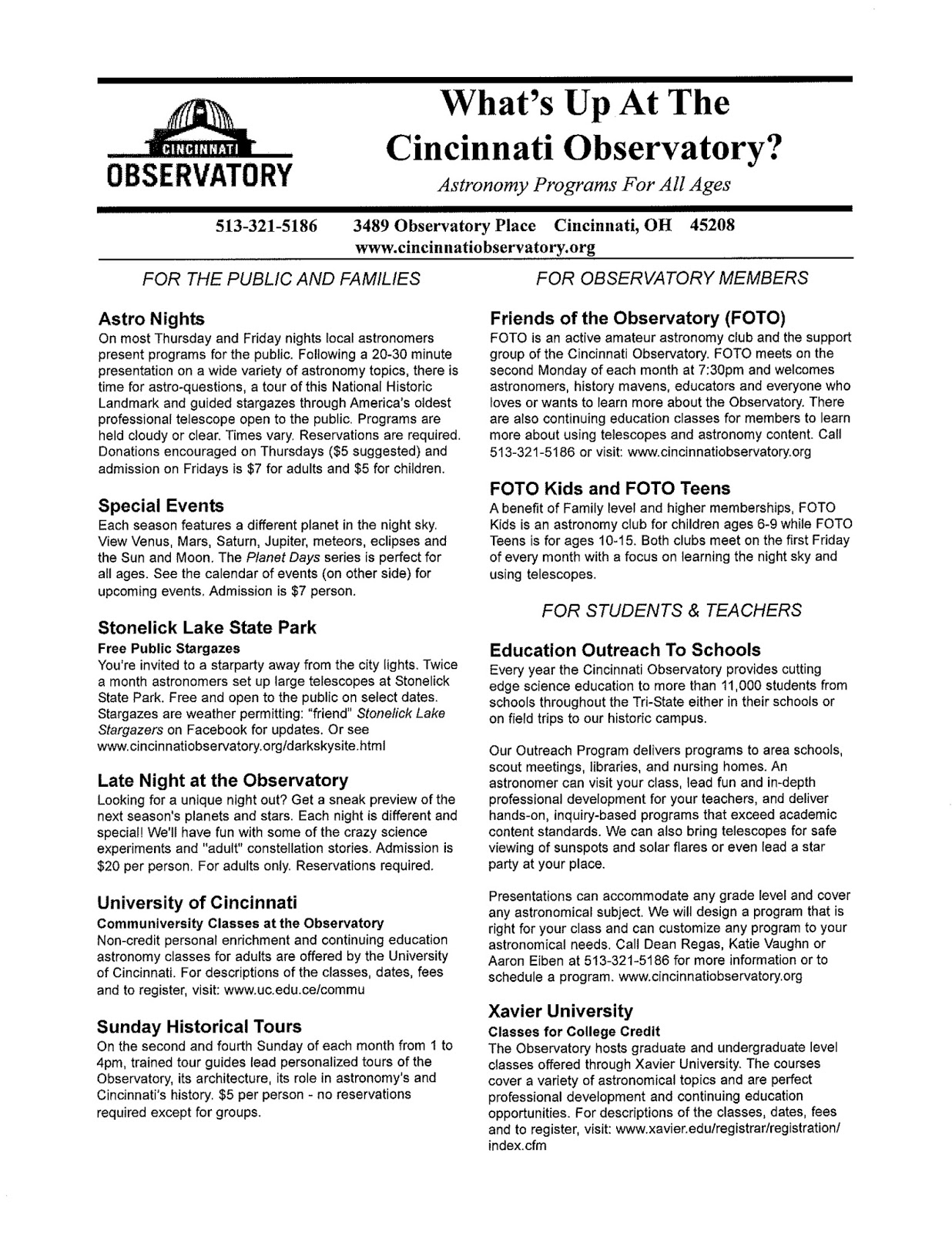
- Cincinnati Observatory
Click the photo to enlarge

Click the photo to enlarge
- Cincy Arts and STEM
Click the photo to enlarge
 

- Glen Helen - http://www.glenhelen.org/#!ecocamp/c1tum

- The Ohio State University - https://stemoutreach.osu.edu/stem-programs/stem-summer-camps

- The University of Dayton Summer Honors Engineering Camp - From June 5-10 or June 26-July Students will explore each area of engineering through hands-on activities.  You will also design and build robots in a weeklong team project, solve real-world engineering problems, investigate career options, and network with practicing engineers.  This is a 6-day residential co-ed camp open to high school students who will be sophomores, juniors, or seniors in the fall of 2016.  Students must have a minimum of a 3.5 GPA.  To learn more please go to www.go.udayton.edu/engr/honors_camp.  If you have questions you can contact Beth Hart at 937-229-5080 or ehart1@udayton.edu.

- The University of Dayton Women in Engineering Summer Camp is July 10-15: Students will learn how engineers creatively use knowledge and technology to improve the lives of others.  They will conduct experiments, use their creativity to solve practical problems, create remarkable inventions, and have the opportunity to network with female professionals in the industry.  This is a 6-day residential program and is open to girls who will be sophomores, juniors, or seniors in the fall of 2016.  For more information about this camp, please go to www.go.udayton.edu/wie.  If you have questions, you can contact Annette Packard at 937-229-3296 or apackard1@udayton.edu.

- The University of Dayton Minority Engineering and Technology Enrichment Camp is June 19-25. Minority high school males who will be seniors in the fall are invited to this weeklong program:  live on campus, conduct experiments, network with professional engineers and visit engineering and science laboratories on campus and at Wright Patterson Air Force Base. https://www.udayton.edu/engineering/k-12-programs/metec/index.php

- Wright State University Go For Launch Camp - June 22-24th
Learn more and register online here!


If you don't find one of these interesting, this site has a national directory to search for STEM camps by state!

Activities

- There are always things happening at the National Museum of the US Air Force! 

- Science Saturdays with Mister C are going on at the Engineers Club of Dayton all summer. Check out the poster below!
Check him out on Facebook too!

If you have other opportunities that should be added to this list, please email them to Arch Grieve at arch.grieve@wright.edu!

Friday, March 4, 2016

ACE Month A Success!


So much happened during ACE Month that it's hard to keep track of it all! We had multiple DRSS Newsroom Journalists on the beat to share some of the great things that happened during this special time of year.

Flower Grams Hit DRSS

By Maryam Boumahchad
 
In ACE month there was a flower gram week. This is where a student would buy a flower for a friend, teacher, and/or sibling to show how much you appreciate them. This month is just for that. Especially this week. The flower gram week was to show how much you care about someone even if in reality you don’t show it. You could also send a note with a flower explaining why you got it and how did that person make you want to send them the flower. I have received a flower from my sister with a note explaining how she appreciated me. I myself have sent a flower and it is a pretty good feeling when you receive one as a surprise.
Maryam Boumahchad holding a Flower Gram from her sister, Fatima. Photo by Jordan Durham.

Story Time During ACE Month

By Maddie Kelly
 
ACE Month was full of big events for students, but among all the spectacle and excitement a quieter event took place. Members of DRSS’s Community Alliance went to sixth and seventh grade English classes to read aloud stories about the damaging effects of bullying and how kids can stand up for themselves and others. Readers went in pairs to the middle school classrooms, where they read either Bully or Junkyard Wonders by Patricia Polacco. Both of the books follow young characters who move to new schools and become victims of bullying. The stories also show how the characters get through their hardships with the support of family, teachers, and new friends. After reading the books, the high school readers encouraged the younger students to discuss how they could prevent bullying among their own class. “I got the chance to experience telling little kids about how bullying has a negative impact on their lives and what they can do if this happens to them. I feel like this was a valuable part of [ACE Month] because it tells children that bullying is against an accepting culture for everyone,” says Fatima Boumachad, a junior and member of Community Alliance. “We are teaching kids how to prevent bullying or how to deal with it.” As ACE Month comes to a close, Community Alliance is proud to have caused a positive change in how young DRSS students view bullying.


DRSS Students Raise Awareness of Human Trafficking


By AJ Uzetta
 
Did you know that an estimated 1,078 children in Ohio are forced into human trafficking each year, and 3,016 more are at risk? On February 25, 2016, DRSS decided to speak out against human trafficking by organizing a campaign for ACE Month, the entire month of February. DRSS promoted the human trafficking campaign by writing the details of the campaign on a large chalkboard in the high school section of the school, reminding students about the campaign during lunch and afternoon announcements, and sending students who participated in the campaign to lunch first. To participate in the campaign, you could either a) wear red clothing, or b) wear a red x on your hand, or somewhere on your body. An estimated half the school either wore red or had a red x on their hand. DRSS’s mission by doing this campaign: raise awareness of the rising issue of human trafficking in Ohio, and across the world, one red piece of clothing or x at a time.
A post from the students' Instagram page, found at www.instagram.com/drss.end.it/

Lights Out, its Culture Fest Time!

By Fatima Boumahchad
 
All the Culture Fest participants were getting ready to set up until all of a sudden, the lights went out. As the coordinator of Culture Fest, this was really unexpected. Nevertheless, Culture Fest was still going to happen! Everyone took out their phones and used their flashlights to light up the room. Although we were unable to play music due to the power outage, it was still a very enjoyable event. There was a huge variety of cultures represented from all around the world! Participants wore clothing representing their culture, made posters, brought artifacts and even food to give people a feel for what their culture is like. Students, teachers, and staff members got the opportunity to learn more about each other. Overall, the second annual Culture Fest was a huge success and definitely a huge part of ACE month.
Photo by Cassady Harris.

Photo by Cassady Harris.

Photo by Cassady Harris.

Photo by Cassady Harris.

Mayor Whaley Comes To Visit

By Keshawn Mellon


During DRSS's ACE Month, the Mayor of Dayton, Nan Whaley wanted to contribute as well. The Mayor came in on Thursday, February 25th, and talked to students in all grade levels about what she does in her role as Mayor of Dayton and how she has sought to transform the city into one that not only accepts different cultures, but embraces them. After talking to the students, the Mayor took questions from them about anything they wanted to ask. The questions ranged from the current presidential debate all the way to how she managed her successful election campaign. Once she was finished answering questions, students returned to class, however some were able to stay behind and ask the mayor some personal questions that they were interested in but didn’t have time to ask in front of the entire class. Mayor Whaley stuck around to answer each of them, and we are very grateful for her taking the time out of her busy schedule to come speak to us!


Mayor Whaley speaks to the 6th grade class.

Superintendent Fisher, Mayor Whaley, and Principal Strickland.

Mayor Whaley stuck around to talk to students after the event as well.

And get a few pictures!

This year's ACE Month wouldn't have happened without its primary organizers - Middle School Counselor, Leah Brough, and Dean of Students, Drew Sears. Many thanks to both of them!

10th Graders Attempt to Crush Cancer Through Integrated Project


By Alex T. Smith
At the Dayton Regional STEM School, the staff and teachers sincerely believe that students have the power to make a difference in the lives of others in our community. Perhaps one of the projects that exemplifies this truth the most is just beginning to heat up, and it’s causing a rippling affect that transcends both traditional learning and typical classroom schedules to bring a message of health to citizens in the Miami Valley and beyond.
Right now the 10th grade students are in the thick of the annual Cancer Project. This is an integrated project between Ms. Tash’s Wellness and Fitness class, and Ms. Reid’s Language Arts class, where students collaborate with one another to educate the general public about various behavioral changes they can make to decrease their risk of developing cancer. The finished product will be a video-based Public Service Announcement (PSA) that will educate people about health risks associated with developing specific types of cancer. This was all modeled after a “Dear 16 year old me” PSA on skin cancer.
A cancer project group brainstorming ideas for their script during Ms. Tash's Health and Wellness class.

The project first began in early February when the sophomores gathered information on a few types of cancer. They did research on what each cancer was like and what affects it has on the body. They learned how the cancer itself is developed and what screenings or early detection methods can identify it. In Language Arts they analyzed “Dear 16 year old me” letters. 
As groups were being decided, each child submitted their first choice and they were then assigned to a group focusing on one type of cancer. Cancer types such as colon, breast, lung, skin, and testicular were chosen because the incidences of these cancers can be reduced by changing certain behaviors, and they have a high survival rate when discovered through early detection.  For example, the chances of developing lung cancer is greatly lessened by avoiding tobacco smoke, and wearing sunscreen when in intense sunlight can reduce the risk of skin cancer. Both of these cancers also have a high survival rate when caught with early detection methods.
Students then wrote a letter to someone in their life that fits their PSA’s target audience to explain how they can change behaviors in their lives to prevent cancer or get screenings to detect it.
In Ms. Reid’s Language Arts class, students focused on writing compelling sentences and using strategies that make their letters more persuasive, like using humor or emotions to convey a point. Learning these strategies allowed the students to make their letters more relatable to the recipient rather than just clinical.  
In years past, some pretty remarkable outcomes have arisen when students have chosen to send these letters to their family members. In most cases, this has led to some powerful moments for the student and their family. Last year, at least one family member was inspired by what their student wrote to make the commitment to give up smoking. 
The next step was for each group to write a script for their PSA. After a script is drafted and revised, each group member has a role in the video-making process. The students have been fortunate to have the assistance of Henry Chafin, a local video artist who creates commercials for local companies. Mr. Chafin is demonstrating important video creation skills and teaching students why each group member’s role is important for making a successful video.
The students are in the process of filming their Public Service Announcement in a makeshift recording studio, set up with professional lights and sound equipment. The rest of the project will involve the students using online editing software to add music and trim the videos to fit the 1-3 minute length required by the rubric. 
Students rehearsing their lines and preparing their shots for their PSAs.

Henry Chafin (left) helps direct students during filming of their PSAs.

Mr. Chafin isn’t the only community member involved in the project. Kettering Cancer Care has generously donated $2,000 for this project to educate the public about how to be responsible for reducing their risk of developing cancer. Another interesting development has been the changing of the 10th grade schedule so that students can be in their cancer project groups for both language arts and fitness class. This has required a tremendous amount of effort and cooperation on all of the parts of the 10th grade teaching team and the school administration. Because of the remarkable teachers and general uniqueness of our school, we have a great amount of flexibility for changing around our schedules in a way that no other school could. Both teachers and students have had to work together to adapt to this new schedule, but over the duration of this six week project, the concessions have more than payed off.
Huthayfa Usman, a current 10th grader, had this to say when asked about the schedule change: “I definitely think this helps make this [Cancer] project more convenient because it gives us all a chance to collaborate without hunting people down.”
I interviewed Ms. Tash about what she wanted her students to take away from this project. She said,” I want them to see that they can help other people improve their health. Advocating for the health of others is a big part of my class, and I want them to see that they have the power to positively impact other people’s lives. To help inspire someone to change their life is a powerful thing. A lot of times a lot of students don’t understand how powerful their abilities to inspire others truly are.”
Given the fact that students in past years have been able to motivate their loved ones to quit smoking and make other health related behavioral changes, it seems that this goal has definitely been achieved. It’s projects like this that make students and members of the community alike, most proud of our amazing teachers and staff, for making special learning opportunities like this possible, and allowing  young minds to make a difference in the community. The cooperation, creativity, and resourcefulness of our staff and teachers are truly what make amazing project-based learning opportunities like this possible. Our wonderful teachers, like Ms. Tash, and Ms. Reid, are constantly doing amazing things to motivate their students. This is nothing out of the ordinary for them, but that in no way makes their efforts any less remarkable. Projects like this can sometimes seem almost ordinary at this school, because our teachers always give their 110% in the lessons they plan. This is all just another day at the Dayton Regional STEM School, a place where our teachers truly make us who we are.

Thursday, March 3, 2016

Choosing A STEMmersion No Easy Task


By Brianna Perkins

The time for choosing STEMmersion has arrived, and some students are having a difficult time choosing from so many great options. I interviewed a group of sophomore students about their personal experiences when it comes to choosing a STEMmersion.
Student registration for STEMmersion began on February 28th this year and took place online.
“You have to choose something that interests you,” Katie Jones, 15, says. Choosing a STEMmersion doesn’t only impact students during the two weeks but also with their future. 
 “I wasn’t interested in biology before doing STEMmersion, but [last year's] Exploring Evolution STEMmersion got me interested in it,” Tony, 15, says. In this STEMmersion, students looked at the different ways plants and animals have evolved.
STEMmersion also gives students a different outlook on some aspects of their lives. “It’s made me more active. It made me realize that there’s more out there; that you can be active and still have fun,” Taryn Hughes, 16, said while talking about the biking course she took last year. During this class, students biked to nearby places, such as the Dayton Art Institute. While there, they were able to explore. When asked about how STEM factors into this particular experience, biking STEMmersion teacher, Arch Grieve, explained, "STEM is everywhere, really. From learning the basic mechanics of how a bicycle works (and how to do basic repairs) to calculating the gear ratios of their bikes by looking at the relationship between pedal revolutions and tire revolutions, STEM is infused into and enriches the entire class's experience."

Former DRSS Teacher, current parent and Math Instructor at WSU, Peggy Kelly, was a guest lecturer for the biking STEMmersion for the past two years.
STEMmersion also helps students by giving options that aren’t available during their normal classes. For some students, like Taryn, that is what makes STEMmersion so much fun. Besides it just being fun, it also inspires students, such as Chloe Johnson, 16. “If you choose the right STEMmersion, it can help you to be more inspired to do things after it.”  

This year STEMmersion takes place from May 18th and runs through June 2nd. A complete listing of all STEMmersion courses can be downloaded from the DRSS website at this link.
 
Whether choosing a STEMmersion for the fun of it, or the activeness of it, it’s always important to keep an open mind.

The STEMmersion Fundraising Challenge is going on now! To learn more, visit our GoFundMe site: https://www.gofundme.com/STEMmersion