Sunday, September 20, 2015

DRSS Team Enterprise Builds Homes Too

The high school robotics team was busy again this weekend - so busy they had to split up to be at two different events! 

Part of the team met on North Fairfield to help build a house for Habitat for Humanity.  Over a span of 4 hours, our team (and a hundred or so others) framed out an entire house. DRSS team members can proudly say that they built 5 of the 68 walls!
DRSS Enterprise team members framing out a window while volunteering for Habitat for Humanity
The window they framed makes a great... well, frame!

The other part of the team met up with three other teams for a strategy session at Starbase in Dayton.  At that session, the teams discussed ways to attack this year's FTC Challenge.  At one point, they had to become "human robots" and act out the strategies they came up with.

Strategy session underway!


Teamwork was the theme of the day, both in terms of preparing for competition and using their skills to help others.

Follow the team on Twitter @DRSSRobotics

Thursday, September 17, 2015

Peer to Peer Instruction at DRSS

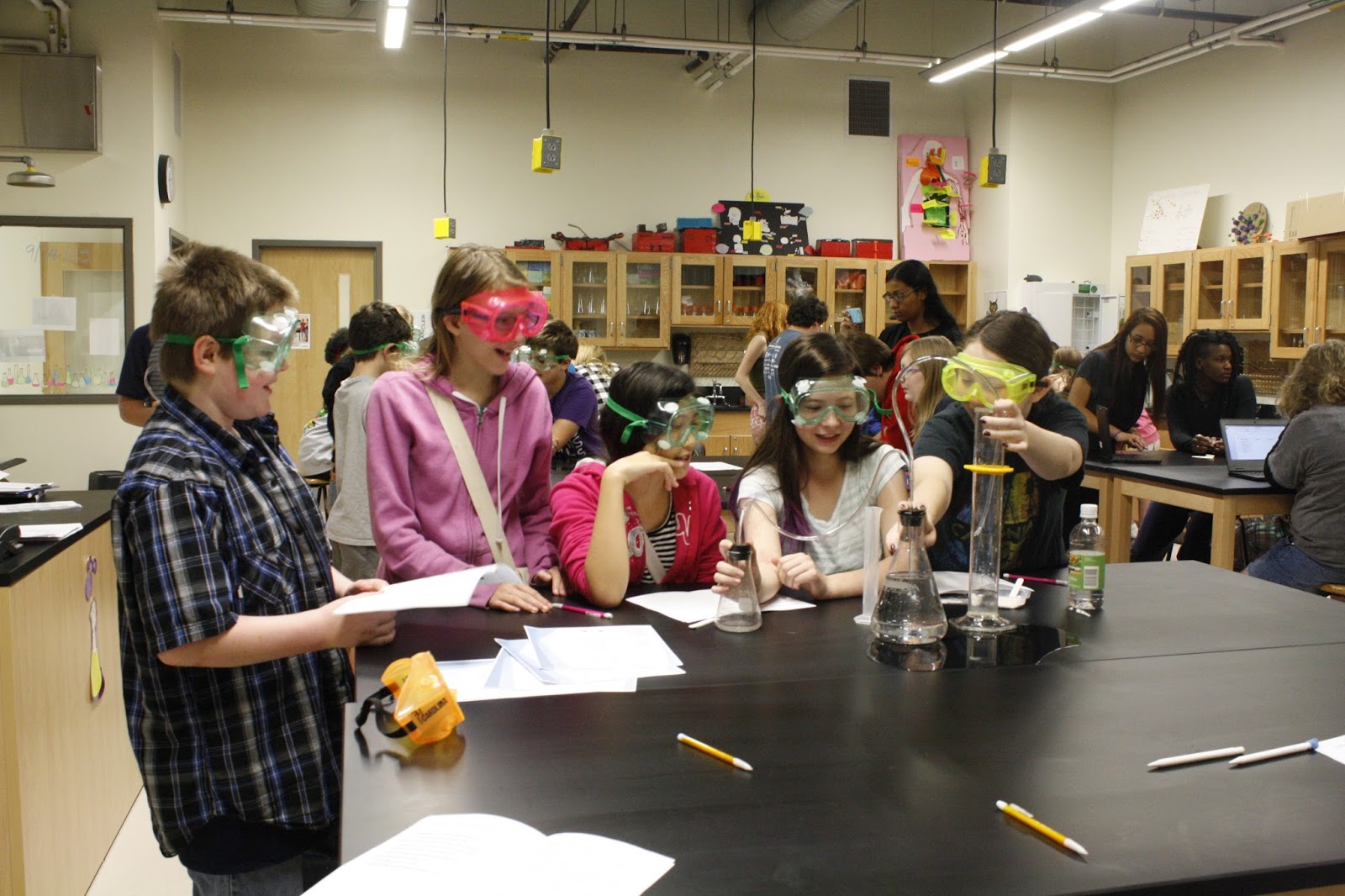
On Wednesday, 6th graders in Mr. Nelson's science class participated in usability tests conducted by 11th graders. This project began in Ms. Kancler's 11th grade chemistry class, where students were introduced to a water-displacement lab. They were tasked with creating quality procedures/instructions so that 6th graders at DRSS could replicate the experiment on their own, using only the instructions created by the 11th graders.

6th graders work through the lab with their 11th grade counterparts.

11th grader Kyleigh Lutz instructs 6th grade peers.

Peer to Peer Instruction is fun for both groups!

Everyone is engaged.

Water usability gets intense!

Billy Nelson helps 6th grade students set up their lab equipment.

In Ms. McDaniel's 11th grade Technical Reading & Writing the students analyzed examples of instructions and lab procedures and learned the criteria and rules for writing clear, understandable instructions for a specific audience.  They learned about their audience’s science vocabulary, drafted their instructions, tested them on their peers, and made necessary revisions for better usability. Finally, the students learned about different types of usability tests and were tasked with creating their own in order to test whether the 6th graders could successfully understand and use their instructions.  After conducting the tests yesterday, 11th graders will use the feedback to make final revisions to their instructions.

11th graders meet with their 6th grade counterparts to go through the lesson and ensure their audience would understand what they had written. This kind of peer to peer instruction provides an authentic audience for the 11th graders and gives our Middle School students a chance to interact with those in the High School.

Tuesday, September 15, 2015

Can You Solve The Locker Problem?

Starting their first year at DRSS in 6th grade all the way through their senior year, students are taught using a wide variety of instructional strategies. One of those strategies is inquiry-based instruction, where students are presented with a question or a problem and then learn the skills needed to solve that problem.

In Brittany Shores 6th grade math class students used this method to solve "the locker problem." Students were presented with the following prompt:
Can you solve the locker problem?! Imagine there are 1,000 students and 1,000 lockers that are all closed. Student 1 goes down the row and opens every locker. Student 2 goes down the row and closes every other locker. Student 3 changes the state of ever 3rd locker. Student 4 changes every 4th locker. This pattern continues until all 1,000 students have had a turn. When all the students are done, which lockers will be left open?
Below you can find pictures of some of the ways in which students attempted to investigate this problem in Mrs. Shores' class, followed by a video in which they test out their concept.


Check out the video below to watch as students simulate the locker problem to test out whether or not their math was correct!


For more about what makes instruction at DRSS unique, check out our website!

Sunday, September 13, 2015

FTC Robotics Team Kicks Off 2015/2016 Competition Year

On Saturday, our First Tech Challenge (FTC) robotics team, DRSS Enterprise, spent the day at the season kickoff and challenge "reveal" at iSpace in Cincinnati. In the morning, while waiting for the worldwide review, teams from all over Ohio met and traded knowledge, hints, and "war stories." Our team was asked to organize a mentor/rookie "match up" for the teams in Ohio and Northern Kentucky, so they manned a booth all day and collected information from experienced teams and from rookie teams that need mentoring. Additionally, since we are one of the top rated teams when it comes to engineering documentation, Terra, Niky, and Alan were asked by other teams for help improving their engineering journals. 

DRSS Enterprise at iSpace in Cincinnati
When the challenge was finally revealed at noon, our teams were in for quite a surprise. This year's challenge is one of the most complex in years, with plenty of engineering challenges to overcome. To see for yourself, check out the video on YouTube.

And so, the competition season begins!

Saturday, September 5, 2015

Senator Peggy Lehner Visits DRSS to Push Matthew's Bill

On Tuesday, September 1st, 2015, Dayton Regional STEM School students held a rally to push for Matthew's Bill, currently labeled SB112 in the OH Senate. This bill was inspired by Jennifer Helton, formerly an intervention specialist at DRSS, and her son Matthew, who has multiple disabilities. Changing him in public restrooms is extremely difficult given the lack of changing tables for adults.

Students in Meghan Durkee's Government Class have been seeking to address this issue by getting legislation passed to fix this issue. They worked with Senator Lehner over the course of the last year to pass the legislation into law, and Tuesday night's rally featured members of the public, including distinguished guest Dr. Tom Sudkamp, Wright State University's Provost, who provided students with feedback on their efforts.

Dr. Sudkamp, teachers, and students discuss the impact of Matthew's Bill and provide students with feedback and ideas on their current legislative efforts.

Students afterwards had time to talk with Senator Lehner one-on-one.

The students' efforts were featured in a story on Fox45/ABC22 that evening. Click here to watch!
The students continue to seek allies for their legislation, and if you are interested in helping them pass this bill into law, please contact them through their website here. For more information on Matthew's Bill, check out their website.

Tuesday, September 1, 2015

Students Visit Montgomery County Solid Waste District Environmental Learning Center

In the weeks before school started you could find 6th grade science teacher Russ Nelson placing ErgoCans around the school. These cans were paid for with a grant that he and 6th grade math teacher Brittany Shores secured through the Montgomery County Solid Waste District (MCSWD) for $4,500. The cans are made from 100% post-consumer materials.
Mr. Nelson and Mr. McNeal placing ErgoCans around the school this summer before classes began.

Students using these ErgoCans are actually putting products into a recycling stream that turns things like drink pouches, snack bags, and foil-lined energy bar wrappers into messenger bags and backpacks. Each item thrown away is worth between one to two cents. It may sound small, but the money is starting to add up. So far they've converted trash into $236.41 from waste they've sent in.

This is the third year for the "Zero Waste Project," which actually began when Russ and Brittany were interviewing to work at DRSS as an integrated project idea that turned into a reality during STEMmersion. That class was so successful that by partnering with Montgomery County, Russ was able to begin teaching a new Sustainability enrichment course, which he is teaching again for the second year in a row.

The students worked on this logo last year to kick off the Zero Waste Project here at DRSS.
On Tuesday, September 1st, 2015, Russ' class went on one of their quarterly visits to the MCSWD's Environmental Learning Center to take a tour led by Education Specialist Chris Hoffman. There, students were also able to see the tipping floor to learn about how their solid waste and recycling materials are processed.
Students get a look at the tipping floor from the balcony.
Chris Hoffman, Education Specialist, explains the science behind how landfills work.
Chris explains how the "Add It Up" simulator works, which allows visitors to plug in their water consumption per day and shows them how much water they use, as well as how they can reduce their consumption.
Students play the "Sorting Game" where they compete to recycle the most acceptable recyclables and electronics. Students lose points for recycle dirty materials or putting them in the wrong bin as they take them off of the digital conveyor belt.
Special thanks to Chris and the Montgomery County Solid Waste District for taking our students on the tour!

Becoming a Zero Waste School is a monumental task, so Russ and Brittany plan to start up the student "Green Team" again this year soon. They're also looking for parents and partner volunteers to help assist with cleaning compost bins, cleaning receptacles, turning compost, revamping the website, and working with students to help accomplish other goals. They're also looking for a matching grant for the a new "earth tub," a fully-enclosed composting vessel which would allow them to greatly speed up the process. If you're interested in helping, please contact them at russell.nelson@wright.edu or brittany.shores@wright.edu.

Russ and Brittany would like to thank Chris Hoffman, Dan Graeter, and Barb Asberry at the Montgomery County Solid Waste District for partnering with them to become a pilot school for the Zero Waste program and hosting the students for quarterly visits, one of which they'll be taking next Tuesday.

Having already shared their lessons learned at a state-wide environmental sustainable materials conference in Dayton this past summer, they hope to begin to share their curriculum and experience with other schools in the area as well!

Saturday, August 29, 2015

Dayton Junior Council on World Affairs Team Places 1st in Region

The DRSS-1 team of the DRSS Junior Council on World Affairs Team, also known as "JAWS COMET" (an anagram for "STEM JCOWA") placed first in the region in 2015 for the second year in a row. This earned them a spot at the national Council on World Affairs Academic WorldQuest Competition, which takes place annually at Georgetown University.
DRSS-1 Team and advisors. From left to right: Arch Grieve (advisor) Ayana May, Vidur Prasad, David Sills, Tess Greene, Tyler Lutz, Bill Clifford (WACA Pres.), and Kevin Lydy (advisor)
The students did not place at the national competition, but they had a great trip and visited the European Union Ambassador's official residence, as well as many famous Washington D.C. stops.

The group met with EU Ambassador David O'Sullivan after hearing him speak and having time to ask him questions about the relationship between the US and the EU.

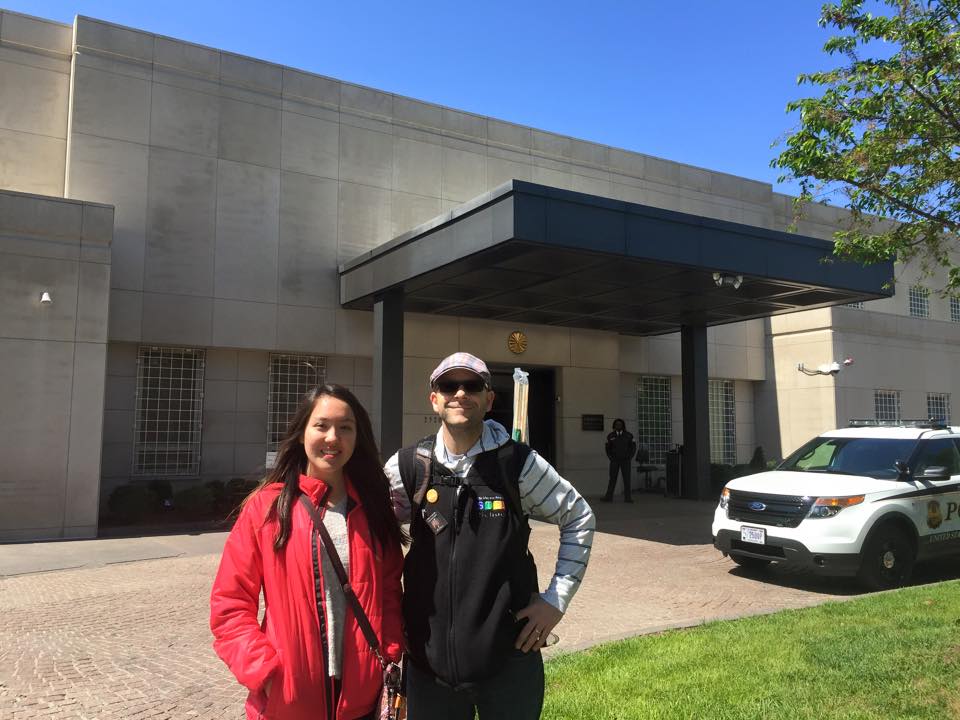
Ayana and Mr. Lydy in front of one of the many embassies the group visited during their tour of Washington D.C.
The group would like to thank the sponsors of the trip - the Dayton Council on World Affairs and Wright State University's College of Liberal Arts.